 Add to Chrome
 Add to Firefox
 Add to Edge
Benchmarking the Limits of In-Context Reinforcement Learning for Ad-Hoc Teamwork
May 23, 2026
In-Context Reinforcement Learning (ICRL) has enabled foundation agents to adapt instantaneously to novel tasks, yet its efficacy in Ad-Hoc Teamwork (AHT)-where coordination with unknown partners is required-remains unexplored. To rigorously evaluate this, we introduce a large-scale benchmark ICRL4AHT, built upon a high-throughput JAX implementation of Overcooked-V2. Our benchmark includes a large, diverse teammate suite spanning both RL and heuristic policies, enabling controlled train-test shifts, and provides a reproducible end-to-end pipeline for teammate generation, learning-history collection, dataset construction, and online multi-episode evaluation. We evaluate representative history-conditioned ICRL algorithms, including Algorithm Distillation (AD) and Decision-Pretrained Transformer (DPT), across millions of transitions. Results reveal notable limitations: contrary to their success in single-agent domains, these baselines fail to exhibit robust test-time adaptation in multi-agent settings. Specifically, these methods frequently underperform random baselines across both unseen teammate and unseen layout tracks, with no clear in-context improvement over long horizons. These findings highlight the challenges of strategic inference under partial observability within the OvercookedV2 AHT protocol, establishing our benchmark as a critical testbed for next-generation coordination algorithms.

PACT: Proactive Asking for Continual Task Assistance in Human-Robot Collaboration
May 23, 2026Robotic assistants in long-term human-robot collaboration need to assist users under partial observations while leveraging cross-day interaction history. However, human traits and routines are often unknown at the beginning of collaboration, making passive infer-then-act assistance ineffective and inefficient. To address this challenge, we study a cross-day proactive asking setting for continual task assistance and propose PACT (Proactive Asking for Continual Task Assistance), an ask-or-act framework that determines whether clarification should be sought before taking action. PACT leverages current observations together with accumulated interaction history to evaluate contextual sufficiency, enabling the robot to provide more reliable assistance and progressively adapt to the user over time. We implement its primary learned instantiation using reinforcement learning and evaluate alternative instantiations under the same framework. To assess such behavior, we further introduce a clarification utility metric that quantifies the trade-off between assistance accuracy and the frequency of clarification requests. Experiments in multi-day embodied collaboration scenarios demonstrate that, compared with passive inference baselines, PACT consistently improves both assistance accuracy and clarification utility, highlighting the importance of proactive asking in continual human-robot collaboration.
DrawMotion: Generating 3D Human Motions by Freehand Drawing
May 20, 2026Text-to-motion generation, which translates textual descriptions into human motions, faces the challenge that users often struggle to precisely convey their intended motions through text alone. To address this issue, this paper introduces DrawMotion, an efficient diffusion-based framework designed for multi-condition scenarios. DrawMotion generates motions based on both a conventional text condition and a novel hand-drawing condition, which provide semantic and spatial control over the generated motions, respectively. Specifically, we tackle the fine-grained motion generation task from three perspectives: 1) freehand drawing condition. To accurately capture users' intended motions without requiring tedious textual input, we develop an algorithm to automatically generate hand-drawn stickman sketches across different dataset formats; 2) multi-condition fusion. We propose a Multi-Condition Module (MCM) that is integrated into the diffusion process, enabling the model to exploit all possible condition combinations while reducing computational complexity compared to conventional approaches; and 3) training-free guidance. Notably, the MCM in DrawMotion ensures that its intermediate features lie in a continuous space, allowing classifier-guidance gradients to update the features and thereby aligning the generated motions with user intentions while preserving fidelity. Quantitative experiments and user studies demonstrate that the freehand drawing approach reduces user time by approximately 46.7% when generating motions aligned with their imagination. The code, demos, and relevant data are publicly available at https://github.com/InvertedForest/DrawMotion.
Learning Athletic Humanoid Tennis Skills from Imperfect Human Motion Data
Mar 13, 2026Human athletes demonstrate versatile and highly-dynamic tennis skills to successfully conduct competitive rallies with a high-speed tennis ball. However, reproducing such behaviors on humanoid robots is difficult, partially due to the lack of perfect humanoid action data or human kinematic motion data in tennis scenarios as reference. In this work, we propose LATENT, a system that Learns Athletic humanoid TEnnis skills from imperfect human motioN daTa. The imperfect human motion data consist only of motion fragments that capture the primitive skills used when playing tennis rather than precise and complete human-tennis motion sequences from real-world tennis matches, thereby significantly reducing the difficulty of data collection. Our key insight is that, despite being imperfect, such quasi-realistic data still provide priors about human primitive skills in tennis scenarios. With further correction and composition, we learn a humanoid policy that can consistently strike incoming balls under a wide range of conditions and return them to target locations, while preserving natural motion styles. We also propose a series of designs for robust sim-to-real transfer and deploy our policy on the Unitree G1 humanoid robot. Our method achieves surprising results in the real world and can stably sustain multi-shot rallies with human players. Project page: https://zzk273.github.io/LATENT/
K^2-Agent: Co-Evolving Know-What and Know-How for Hierarchical Mobile Device Control
Feb 28, 2026Existing mobile device control agents often perform poorly when solving complex tasks requiring long-horizon planning and precise operations, typically due to a lack of relevant task experience or unfamiliarity with skill execution. We propose K2-Agent, a hierarchical framework that models human-like cognition by separating and co-evolving declarative (knowing what) and procedural (knowing how) knowledge for planning and execution. K2-Agent's high level reasoner is bootstrapped from a single demonstration per task and runs a Summarize-Reflect-Locate-Revise (SRLR) loop to distill and iteratively refine task-level declarative knowledge through self-evolution. The low-level executor is trained with our curriculum-guided Group Relative Policy Optimization (C-GRPO), which (i) constructs a balanced sample pool using decoupled reward signals and (ii) employs dynamic demonstration injection to guide the model in autonomously generating successful trajectories for training. On the challenging AndroidWorld benchmark, K2-Agent achieves a 76.1% success rate using only raw screenshots and open-source backbones. Furthermore, K2-Agent shows powerful dual generalization: its high-level declarative knowledge transfers across diverse base models, while its low-level procedural skills achieve competitive performance on unseen tasks in ScreenSpot-v2 and Android-in-the-Wild (AitW).
Game-Theoretic Co-Evolution for LLM-Based Heuristic Discovery
Jan 30, 2026Large language models (LLMs) have enabled rapid progress in automatic heuristic discovery (AHD), yet most existing methods are predominantly limited by static evaluation against fixed instance distributions, leading to potential overfitting and poor generalization under distributional shifts. We propose Algorithm Space Response Oracles (ASRO), a game-theoretic framework that reframes heuristic discovery as a program level co-evolution between solver and instance generator. ASRO models their interaction as a two-player zero-sum game, maintains growing strategy pools on both sides, and iteratively expands them via LLM-based best-response oracles against mixed opponent meta-strategies, thereby replacing static evaluation with an adaptive, self-generated curriculum. Across multiple combinatorial optimization domains, ASRO consistently outperforms static-training AHD baselines built on the same program search mechanisms, achieving substantially improved generalization and robustness on diverse and out-of-distribution instances.
GTR-Turbo: Merged Checkpoint is Secretly a Free Teacher for Agentic VLM Training
Dec 15, 2025Multi-turn reinforcement learning (RL) for multi-modal agents built upon vision-language models (VLMs) is hampered by sparse rewards and long-horizon credit assignment. Recent methods densify the reward by querying a teacher that provides step-level feedback, e.g., Guided Thought Reinforcement (GTR) and On-Policy Distillation, but rely on costly, often privileged models as the teacher, limiting practicality and reproducibility. We introduce GTR-Turbo, a highly efficient upgrade to GTR, which matches the performance without training or querying an expensive teacher model. Specifically, GTR-Turbo merges the weights of checkpoints produced during the ongoing RL training, and then uses this merged model as a "free" teacher to guide the subsequent RL via supervised fine-tuning or soft logit distillation. This design removes dependence on privileged VLMs (e.g., GPT or Gemini), mitigates the "entropy collapse" observed in prior work, and keeps training stable. Across diverse visual agentic tasks, GTR-Turbo improves the accuracy of the baseline model by 10-30% while reducing wall-clock training time by 50% and compute cost by 60% relative to GTR.
Multivariate Diffusion Transformer with Decoupled Attention for High-Fidelity Mask-Text Collaborative Facial Generation
Nov 16, 2025While significant progress has been achieved in multimodal facial generation using semantic masks and textual descriptions, conventional feature fusion approaches often fail to enable effective cross-modal interactions, thereby leading to suboptimal generation outcomes. To address this challenge, we introduce MDiTFace--a customized diffusion transformer framework that employs a unified tokenization strategy to process semantic mask and text inputs, eliminating discrepancies between heterogeneous modality representations. The framework facilitates comprehensive multimodal feature interaction through stacked, newly designed multivariate transformer blocks that process all conditions synchronously. Additionally, we design a novel decoupled attention mechanism by dissociating implicit dependencies between mask tokens and temporal embeddings. This mechanism segregates internal computations into dynamic and static pathways, enabling caching and reuse of features computed in static pathways after initial calculation, thereby reducing additional computational overhead introduced by mask condition by over 94% while maintaining performance. Extensive experiments demonstrate that MDiTFace significantly outperforms other competing methods in terms of both facial fidelity and conditional consistency.
Deep (Predictive) Discounted Counterfactual Regret Minimization
Nov 11, 2025Counterfactual regret minimization (CFR) is a family of algorithms for effectively solving imperfect-information games. To enhance CFR's applicability in large games, researchers use neural networks to approximate its behavior. However, existing methods are mainly based on vanilla CFR and struggle to effectively integrate more advanced CFR variants. In this work, we propose an efficient model-free neural CFR algorithm, overcoming the limitations of existing methods in approximating advanced CFR variants. At each iteration, it collects variance-reduced sampled advantages based on a value network, fits cumulative advantages by bootstrapping, and applies discounting and clipping operations to simulate the update mechanisms of advanced CFR variants. Experimental results show that, compared with model-free neural algorithms, it exhibits faster convergence in typical imperfect-information games and demonstrates stronger adversarial performance in a large poker game.
AFM-Net: Advanced Fusing Hierarchical CNN Visual Priors with Global Sequence Modeling for Remote Sensing Image Scene Classification
Oct 31, 2025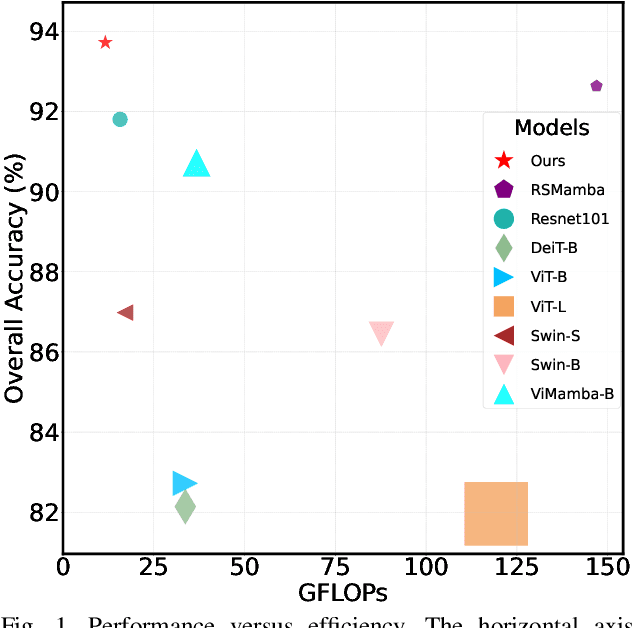
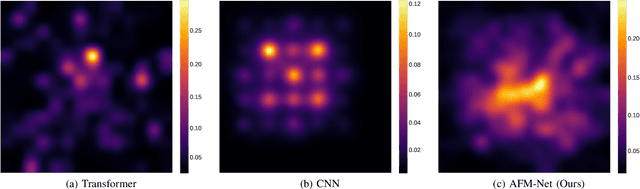
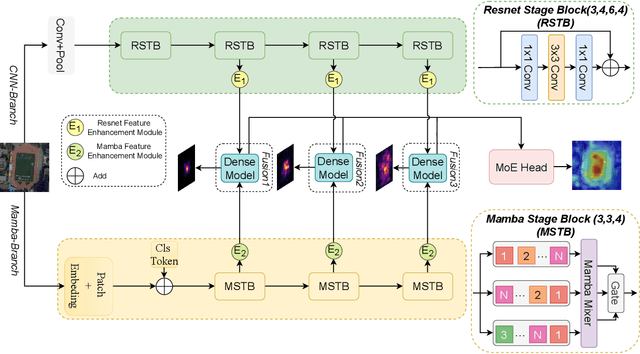
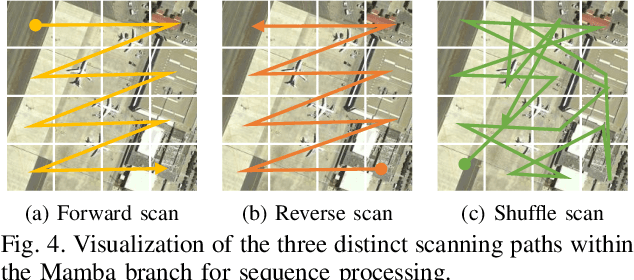
Remote sensing image scene classification remains a challenging task, primarily due to the complex spatial structures and multi-scale characteristics of ground objects. Existing approaches see CNNs excel at modeling local textures, while Transformers excel at capturing global context. However, efficiently integrating them remains a bottleneck due to the high computational cost of Transformers. To tackle this, we propose AFM-Net, a novel Advanced Hierarchical Fusing framework that achieves effective local and global co-representation through two pathways: a CNN branch for extracting hierarchical visual priors, and a Mamba branch for efficient global sequence modeling. The core innovation of AFM-Net lies in its Hierarchical Fusion Mechanism, which progressively aggregates multi-scale features from both pathways, enabling dynamic cross-level feature interaction and contextual reconstruction to produce highly discriminative representations. These fused features are then adaptively routed through a Mixture-of-Experts classifier module, which dispatches them to the most suitable experts for fine-grained scene recognition. Experiments on AID, NWPU-RESISC45, and UC Merced show that AFM-Net obtains 93.72, 95.54, and 96.92 percent accuracy, surpassing state-of-the-art methods with balanced performance and efficiency. Code is available at https://github.com/tangyuanhao-qhu/AFM-Net.